
Joe (J): Thanks for getting together to talk about your family experiences with Cody. I’ve known you both for a long time, but am sure there will be some new information here.
Response (R): We’re happy to have the chance to talk about this, and appreciate your time devoted to the book.
J: How did you choose Cody’s name?
R: We picked Cody because we liked the name; it didn’t have any special significance, but we liked the western feel to it. Cody’s middle name is James, after his grandfather.
J: Was there anything unusual about your pregnancy with Cody? Was it a difficult delivery in any way?
R: Yes, it was a long labor – twelve hours – and ended with a C-section, but there was no fetal distress.
J: Cody has an older brother, Austin. How old was Austin when Cody was born.
R: Austin was two and a half years old when Cody was born. Cody also has another older brother and sister who were adults at the time Cody was born. Also. we had a similar labor with Austin, it did not progress and ended in a C-section as well. Austin had no effects, and was a star athlete. So there does not appear to be anything about the birth connected to the autism.
J. Tell me about the process of Cody’s autism diagnosis. When did you first begin to suspect something, and when was the diagnosis confirmed?
R: We recognized early on, maybe around one year, that he did not make eye contact and was non-verbal. We also noticed behavioral issues, like screaming for what seemed like no reason. Around 18 months, we noticed repetitious behavior. For example, he would lie on the floor and move a toy bus back and forth while other kids around him were playing. We would call his name and he would not look at us and he was still non-verbal. About that time, my (Glori’s) sister asked, “what is wrong with Cody?” as she watched his repetitious behavior during play. We said there was nothing wrong and that he was just slower than his brother, Austin.
Cody was officially diagnosed with autism at age two and-a-half in 2003. We were still in a kind of denial, or at least were hoping for the best up until the diagnosis came.
J: What did you go through when you first heard the diagnosis? How did you process the news?
R: I (Glori) was overwhelmed when I first heard the news. Matt wasn’t with me, because we didn’t expect bad news on that doctor’s visit. The pediatrician told us before this that Cody would be caught up by kindergarten – that was part of the diagnosis. We were also hoping that early intervention would help, but that didn’t pan out the way we hoped either.
J: I’m sure life changed dramatically for you from that point. Describe some of the major changes and how you responded to the news.
R: First, we were overwhelmed by all the news. The doctor handed me (Glori) a piece of paper with ten characteristics of autism and said Cody had all of them. We were told he would need 30 hours per week of special therapy and habilitation. We were also told we could get services from the state and that we should apply for developmental disability services. All we could think initially was, how will we be able to handle all this?
I (Matt) was still in denial for a bit, but we both soon realized it was true and we had to deal with all the coming life challenges. We decided that Glori should leave the workforce to be with Cody for a season and to take care of all the appointments and needed care. Once we established a care routine, I (Glori) was able to return to the workforce. That was about two years after leaving work. I went back and worked at my church, which made life a little easier. They were very kind and accommodated our needs.
J: You are both Christians, strong in your faith and commitment to the Lord. What role did faith play through the process of those changes?
R: Faith was everything for us. We never questioned God or got angry with him. In fact, we decided early on that Cody was a gift from God, and that He would give us the grace for whatever would be required. We also came to realize early on that having Cody awakened a kind of deeper and unique love in us, something more than we had ever experienced. We were also determined to raise Cody in the faith, in the belief he could have a relationship with God.
J: You were both instrumental in the creation of a special needs ministry at the church. It was not your intention to do so, but it happened because of you. How did that come about?
R: We weren’t thinking about a special needs ministry right away. It is kind of a cool story how this came about. Because Cody could be disruptive, and loud, and couldn’t be left with kids his age level, one of us would go to church and the other would stay home with him. That was our plan initially. I (Matt) was at a leadership meeting and mentioned that the church would see me every other week because of our arrangement. To my amazement, the leadership said my idea was “unacceptable,” and that the church would instead start a special needs ministry. That’s how it began and Cody was the first child to enter it. That was over eighteen years ago, and the ministry has grown steadily since.
J: As Cody grew, there were undoubtedly difficult stages. What were some of those difficult times, and how did you navigate the challenges?
R: There was a brief time when Cody got physically aggressive. His motions could get so intense, that he could injure people. It started when he was about seven and lasted for some number of years- I’m not sure exactly. It tapered off pretty quickly, fortunately, but it was a difficult period. It was a combination of hormones and diet, and teaching him coping skills – we were glad to have it pass. Cody is actually a gentle soul, but there were a few difficult years until we figured it out.
School was also challenging. The school didn’t understand the challenges of autism and someone like Cody, who did not fit the pattern they wanted. His presence could be disruptive to the class. Some of the teachers used unkind descriptions and were looking to quarantine him to not bother other students. We realized they did not know how to handle him and made a decision early on to transfer him to private school. It was the right move for all concerned. We would recommend that to any parents facing this – if a school is not able to handle the needs of your child, you have to try alternatives, as difficult as that may be. For example, a school-appointed doctor was examining Cody for placement, and stopped the test to announce (in front of Cody) that testing was pointless, and that he was “retarded.” We understand now that even experts knew less about autism back then and mistakes were made. The important thing for people now is to watch at every step and advocate for your children.
Being in social settings was also very challenging. When Cody went into outbursts, like screaming, crying, or running, we sometimes would get angry stares. People did not understand what we were dealing with. Cody loved to go to Austin’s football games and Austin had great wisdom for us. At a young age, he realized people did not understand Cody’s acting up, and that we should just smile at them and ignore their looks since they did not know better. We could give many examples, but some people’s comments were particularly hurtful. In stores, we heard things like we should be “controlling” his behavior, or asking why we were still carrying him when he was four years old.
Another thing – people give advice without understanding the situation. They mean well, but can be insensitive. For example, people would ask us, what kind of a home will you place him in when he is older? Our hope is that he will continue to live with us, be as independent as possible, and eventually live with his brother Austin. Cody has come very far, and even has a job now.
But we have to add that other people smiled and were encouraging – we never forgot those times and kind looks. Someone would come up and say we were special parents and they felt for us. Those understanding looks and smiles went a long way. We wish more people were informed and thought that way.
J: Tell me about Cody’s education. When did it begin, and how was he introduced to learning?
R: Cody did not fit in well in public education. He started at a learning center at age 4, but sat in a corner by himself and did not participate with other kids. He finally went to a special school for autism and he did much better. He was able to learn, in fact more than we knew at the time, and loved the school structure. He was upset to graduate from his special academy, since he liked the people there and made friends. The teachers created a great environment. But they also instilled a love for learning. Cody still enjoys learning and communicating about new ideas and information.
J: When did you first suspect that there was much more happening inside Cody than anyone knew? Were there hints along the way?
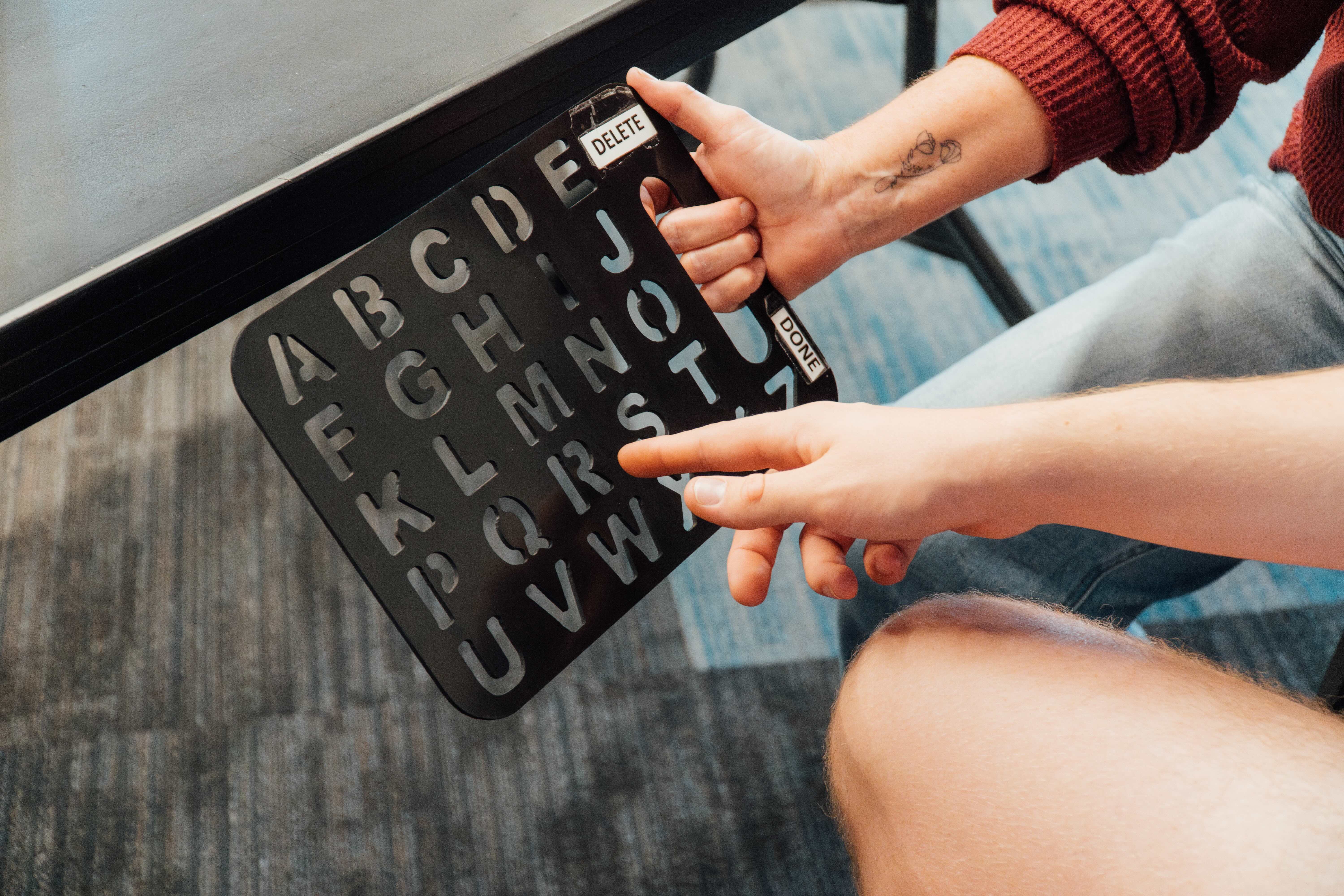
R: It was not until he started his spelling-communication program. That was about two and a half years ago. We didn’t realize it immediately when he started spelling. We were surprised to see he could communicate that way, but it wasn’t until about six months into the spelling therapy that we realized he knew and understood much more than we suspected. And it just kept building – we were astonished by it. Every time we saw Cody spell bigger words, or express more complicated ideas, our amazement grew. We found it hard to believe and it kept exceeding all our expectations.
We read a book called “Underestimated” written by a father on a similar journey. That father’s experience and emotions matched ours – we literally cried as we watched Cody answering open-ended questions, using polysyllabic words. We’ve come to grips with it, but at times it still amazes us and makes us very emotional. And learning about his faith in Christ blew us away. The recent talks about his seeing into the spiritual realm were the next surprise and we are still processing that.
Cody even knows current affairs and has political views. He has talked to us about the U.S. Constitution. He likes Hallmark movies – he takes after his mother with that – and he loves to watch (and understands) football. From a young age, he would sit and watch games. Now that he is communicating, we have discovered that he has a knowledge of the teams and players. Oh, and he likes basketball too. We could go on with much more.
J: What has the availability of a special need ministry meant to you and your family?
R: Knowing that Cody is loved and safe is huge. It has provided us with comfort to know he is hearing about Jesus, and that he is loved and accepted by others. The acceptance part is so important to us after all Cody experienced as a child. Plus, the ministry has freed both of us up for our own ministries. It has also made a big difference in Cody’s life through events he can participate in. He loves the annual Night to Shine, where he wears a tuxedo and takes his date to a prom-like event. He has had parts in theater productions, performed entirely by special needs participants. We have seen other parents crying in the audience, to witness something they never thought possible.
As well, having Cody in the program has shown us the value of helping other places to start similar ministries. For example, God has allowed us to help start works in Romania, Mexico, and now we are helping a foundation in Uganda, as well as several churches in town. Jesus commands us to bring in “the lame” and underprivileged. We are doing that in obedience to his command. It has been so much of a joy to see that and to see the impact we are having on other families.
J: The statistics on divorce for parents of special needs children are staggering. Some Internet sources report a divorce rate as high as 80-85% in the case of autism. How has your relationship and marriage stayed so strong in the face of your challenge?
R: First, Jesus has to be the center of everything. We view Cody as a gift and assignment from God. The Lord chose Cody to be our son; we want to make the most of the assignment He has entrusted to us. Next, communication is essential. That is important in all marriages, of course, and a part of the marriage counseling we do for other couples.
But in communication, we focus on coming together to reach a decision. Matt tends to be more of a disciplinarian, and Glori is more tender. We realize we both bring important perspectives and God wants us to listen respectfully and come to a joint decision. We don’t focus on someone being “right,” but instead on how we will deal with an issue together. That unity is critical, and we work toward it and respecting each other.
We have also learned not to take things personally. Too many people do, and hold it in. In the days Cody was acting up physically, we always remembered that it was something he could not control and that he was going through difficult periods of his life. We forgive quickly and do not bring up old issues. When we make a wrong decision, we face it, learn, forgive, and move on from there. That forgiveness and extra understanding is so important and something we all need to work on. As an aside, I (Matt) have been working with many couples over the years in marriage counseling. It has been helpful to see the mistakes and patterns and to realize we are not above making those same errors.
J: What practical advice can you give to parents struggling with the same news? Are there steps you took that you can recommend to others?
R: Aside from what we have already said about forgiveness and moving on quickly, there are practical things a family can do as well. I (Matt) created a document on this that we use in counseling. First, get the support of other people, family, friends, and people at church, who have experienced this and can walk with you on this journey. We need to take things one day at a time. Jesus said that each day presents challenges for itself, and not to worry about the next day. Yes, we make long-term plans of course, but don’t live in worry. Look to the challenge of the day and meet it with love, flexibility, and as much support as you can get from others on a similar journey.
Here is one critical point. People cannot neglect their marriage and time with each other. We plan for 15 hours of intentional time with each other each week, focusing on emotional needs, recreation, and our personal relationship. Wherever possible, we try to get a full eight hours of sleep. If our bodies and minds are not well-rested, we will not deal as well with things. We count our devotional time together in that 15-hour goal; we try for that every morning, as well as our time together in church. A couple has to prioritize their relationship – too many do not, and that is why we have a staggering divorce rate. Statistics show that divorce is very low, almost non-existent, for couples who pray together daily and make that time.
If there are siblings, make sure to focus on them and give them priority time as well. Be intentional with them and be involved in their lives. Allow siblings to express their feelings, including how they may be struggling with a special needs sibling. Include them in family discussions and make them a part of the process. By doing this, we have seen a special bond forged between Cody and Austin. We’ll let Austin describe that for himself.
Here is another very important point. Parents with a special needs child can wrestle with shame, guilt, or a feeling they did something wrong. Sometimes people don’t even know why – was it something I did, or didn’t do, during pregnancy? Could I have done something differently? You have done nothing wrong – and even if we assumed someone did for argument’s sake, there still is no condemnation to those in Christ. Your child is a beautiful gift from God, to show the wonders of his creation. We love Psalm 139:13-16, which says:
“You formed my inward parts; you knitted me together in my mother’s womb. I praise you, for I am fearfully and wonderfully made. Wonderful are your works; my soul knows it very well. My frame was not hidden from you, when I was being made in secret, intricately woven in the depths of the earth. Your eyes saw my unformed substance; in your book were written every one of them, the days that were formed for me, when as yet there was none of them.”
Let that sink in. Jeremiah tells us that God knew us when we were still in our mother’s womb. Everything is known to him. There is no place for guilt or shame, but it may take us some faith to actually believe that. It’s like the story in John chapter 9, about a man who was born blind. The apostles saw the man and asked Jesus, who sinned that this man was born blind? The man himself, or his parents? They were assuming someone sinned – if someone was born with a problem, it had to be someone’s fault. We seem to have a natural inclination that way. Jesus’s answer is for everyone who has a special needs child: Neither he nor his parents sinned. He was born blind so that the works of God might be displayed in him. That has helped us tremendously. Cody was born with autism, but we know that God has a purpose for his life. We always believed that, and never doubted it from the beginning.
We always thought – we will be able to comfort other families as we walk through this – and we were right about that. But there were things we could have never dreamed of. Cody has taught us to love in a way we would have never experienced otherwise. He has opened our eyes to how God deals with us in our weaknesses and lack of ability. We have discussed this with each other; and we believe that we would not have the same understanding of God’s love if it were not for Cody. Now, we are seeing yet another side of what God intended. Cody has an understanding of the spiritual world we could not have guessed in our wildest dreams. And the plan he says God has for his life is still being revealed. We are blown away by the wisdom and working of God. As the Bible says, He is able to do exceedingly more than we can ask or even imagine.
One final thought. We would tell all parents to be encouraged, no matter what they see now. Celebrate in every level your child is able to reach and in what they can give. Sometimes, the surprise we get from special needs children is the gift of unconditional love. That gets us closer to how God loves us.
J: You are both involved in marriage counseling, Matt – you in particular in your pastoral role. Are there principles from your counseling that would apply here?
R: Yes, of course. A major issue is communication. Disagreements are inevitable and can lead to conflict. Each spouse has to be intentional about hearing the other person’s heart, and not thinking they have all the answers. Parenting, like other marriage issues, is a partnership and must be approached that way. Our marriage counseling focuses heavily on communication, but that need is amplified with a special needs child.
We remember as well, that Cody was born with autism, but that his condition does not define him. We continually remind ourselves of that and take it as a foundational understanding as we approach matters that could cause division. But the biggest thing that comes to mind is communication. It is essential, even when you don’t feel like it. Speak early, and speak often. Listen to each other respectfully, and make those plans in agreement. We have a communication module in our teaching material that we would make available if people wish.
J: What is the one thing you wish you knew before entering into the world of autism? Looking back, what do you wish someone had explained to you or warned you about?
R: To me (Glori), I don’t think there is much that would have made a difference. I tend to take one day at a time, so how we responded to this might not have been much different. But there is one big thing I wish we knew. I wish we had understood earlier how much there was inside Cody, and how much he understood about things around him. There were so many times we spoke, where we could have included him more. We did include him in conversations and did the best we could with what we knew. I talked to him about things like school and church plans and knew he wanted to hear about those type of things. There was just no way to know how much more was getting through than what we thought. Even what some people called “behavioral” issues turned out to be his frustration at the brain-language disconnect. But think about that; how would any of us have reacted if we were stuck in that situation, and couldn’t get it out to others?
We always desired as well for people to acknowledge and talk to Cody, especially family and friends. I’m glad now that we did that and it meant a lot to Cody. There is still some frustration for me (Glori) when people don’t stop to say hello to him, or take a minute to comment on something with him. We always knew Cody was very intuitive with people, and discerning. He knew who the people were who cared about him. But again, none of us knew what was really going on in his life and thoughts.
We even sometimes wrestle with a little guilt that we did not know this sooner and treat Cody differently when he was younger. But we have to remind ourselves, we did what we thought was best then with the information we had available – what the experts told us. We would say to others, always assume competence -that your child with autism is seeing and understanding much more than you realize. But our early conversations with Cody would have been different. We would have spoken more to him, and less around him. And, of course, we would have started communicating with him through the spelling board much sooner. Even with yes-no questions when he was younger.
We also would have liked to have had an accurate diagnosis earlier, but that may be something that couldn’t be helped.
J: What has been the biggest adjustment for you with Cody’s newfound voice? What has it been like getting to know more about him than you ever thought possible?
R: Wow. There have been many times of joyful tears as we sat and watched him speak. We were blown away to really “meet” him. At times, it still makes us cry. He talks about what he likes and his fears. He tells us details, like how he doesn’t like what he looks like with his bulky headphones, and how he was happier when we bought him slimmer ones. He tells us about his relationship with Jesus and his desire to make his life count for the Gospel. How would any parent react to that? He told us he has been waiting all his life to tell us about Jesus. How can we even process the emotions, joy, and overwhelming feelings on hearing that?
We are working more on spelling with him at home. This is a huge difference – we speak to him knowing he understands all we are saying. We have apologized to him for things we didn’t know hurt his feelings; he is very forgiving. And we don’t speak to him in a patronizing way. We speak to him as the young man he is, who hears everything and wants to let us know what he is thinking.
J: If parents facing this situation want to get in touch with you, how can they do so? And what other resources are available for families that you would recommend?
R: First, we want to focus on the family dynamics. We mentioned the high divorce rate earlier, and that is key here. We want marriages and families to stay strong – that has to be a priority. Here are some books we use in our marriage counseling:
“The Marriage Builder,” by Larry Crabb (this book explains the meaning of marriage).
“His Needs Her Needs,” by Dr. Willard F. Harley (practical tools for marriage).
“Sheet Music,” by Dr. Kevin Lehman
“Abiding in God’s Presence-31 Day Devotionals for Life,” by Stephanie O. Hubach
Small groups, especially within a larger church, are vital as well. Parents and families need that common support and encouragement, to know they are not alone. We all face those times with setbacks or discouragement. There is no substitute for having the Body of Christ to gather around you, to pray and walk through each step of life. Speaking to people who have been there, and can act as guides, is very valuable.
If people want to reach out to us, we can explain more about our marriage counseling program, and what we teach. On the subject of special needs ministries, we are big fans of “Joni & Friends.” They have extensive resources and events like retreats, conferences, and training, on how to set up and run a special needs ministry.