
Q: What is your background with special education, and when did you first feel drawn toward it?
M: Honestly, I knew from the time I was eight years old that I wanted to work with people with disabilities. I read books about it, watched movies, and was drawn to helping those people. When I was in high school, for example, I helped a mother with her special needs child. It didn’t feel like anything unusual – just what I wanted to do. I feel like God created me with this desire. When it was time for college, I went to Arizona State University and majored in special education and then got my Masters degree in special education at Northern Arizona University. Honestly, I can’t recall a time when I ever saw myself doing anything else. It has just always been a part of who I am.
Q: What was it about the special needs ministry that attracted you? Do you still feel the same way about it?
M: Special needs ministry wasn’t something I was thinking about early on. To answer this, I have to think back on how God has worked in my life. I grew up in a Christian home, but I didn’t really surrender my life fully to him until I was 31 years old. My husband, Doug, and I had two children, and were experiencing one of those watershed moments in life – a time where you think about what you really believe and make decisions about how to live. I think having two small children may have been a part of that – even if you aren’t consciously thinking about it, part of our thinking was, how will we raise our children?
After giving my life fully to Christ, I still had the same passion and love for people with disabilities, though I didn’t have any idea how God would use it. Looking back now, I can see God’s hand all over this. Would I have done it if God had showed me all this in advance? I kind of doubt it. I’m shy and introverted by nature. But I see now how God has led me in the process step by step – he knows the speed I needed – to where I am today.
But I guess it comes down to this. I always had a heart for people with disabilities. Once I gave my life fully to Christ, He got that gift in me on the right track, and is now using it for his purposes. Of course, I still feel the same way – in fact, I feel even more passionate about what I do now. It grows with every milestone, and I can’t imagine a church without this kind of outreach.
Q: What has been the most satisfying part of what you do?
M: It is so powerful and beautiful to watch broken parents come to the church and find a place where their children are celebrated and have a place. And, of course, there is the student’s journey. These kids are often forgotten, overlooked, and even sometimes ridiculed. Seeing these individuals find their gifts, and seeing them come to understand how they have a place in life, is gratifying beyond description. For example, I just watched a little girl spelling, who had the first conversation of her life with her father. He just cried and couldn’t stop thanking me. I think of how that relationship has blossomed from so small a start. I feel privileged beyond belief to be a part of that and to help both the parents and their children enter this new level of relationship.
It changes everything in a family. It gives hope and affirms bonds of love that were there, but may have been difficult to express. Another example, our special needs ministry did a performance of the musical, Aladdin. The cast was composed of teens and adults with special needs. They sang and danced, even did choreographed moves, and showed emotion. They were put in a light that most were never seen in before. It showed everyone that these kids are capable of great things. I saw many parents watching on the sides of the room, bawling, amazed, and so taken with what their children could do.
Those people also find a community that might not otherwise exist for them. There is nothing in the world – no amount of money, or anything, that could take the place of what I felt from being a part of that.
Q: In what ways does your Christian faith inform how you conduct your ministry?
M: I can’t really separate my faith from anything I do in life. It’s not an aspect of who I am, but rather something that defines everything I do in life. As I studied more about disabilities, I also read a lot on the theology of special needs ministry. The two go together so naturally. We see so clearly how much love God has for the “least of these” among us. The two have grown side-by-side so naturally that I can’t separate them.
We’re called to be like Jesus. Jesus surrounded himself with people who had disabilities. His greatest miracles were done on or for the poor and hurting people around him. The greatest disability He came to heal is our sin, of course. But his love for people who were hurting, despised, and broken is an essential part of who He was. I believe we are all called to follow that lead, however we take part in it. And I believe that he equips us in what He calls us to do. I can think of many things that I feel totally incapable of doing, but by His strength and His leading, I can do far more than I dreamed. Let me be clear – it is not anything in me, but what Jesus can do with the little I am able to give him without reservation.
Q: Let’s go back to the founding of Highlands’s special needs ministry. Were you involved in the formation of that? (If not, when did you first get involved?)
M: Doug and I started attending the church around twenty-one years ago. We went through the membership process and I met the pastors. One of the pastors asked me what I did and I told him. He got excited and said the church was just planning to start a special needs ministry and asked if I would be interested in helping with it. I told him of course, I’d be happy to help – but that was all I thought of it – that maybe I could help out a bit. Never in a hundred years would I have imagined myself leading the ministry. That, again, is a God thing.
I attended the first meeting to explore what it might look like to launch a special needs ministry. I recall crying the whole way to church; this was out of my comfort zone and tough for my natural shyness. At the meeting, I barely spoke. That gathering was where I met Matt and Glori, Cody’s parents. There was a lot of interest and a number of people, some of whom worked in the special needs field. We ended up forming a committee and decided to go to various churches with special needs ministries (there were not many of them) to get information.
The planning took several months and then we met and went through the information. We also did some training and reached out to Joni & Friends for help, and we finally felt it was time. About six months after that second meeting, we opened the doors and started the ministry. We started with one person – Cody – and no room to meet. Four-year-old Cody and I took many walks around the property, talking about Jesus, and about life. That was the start of the ministry.
Q: What do you recall about the early days of the ministry? What were the unique challenges?
M: There was no space for us to meet. That was certainly a big one, and it was difficult getting volunteers to help us. I think it is because they are initially intimidated by helping people with special needs. They didn’t know what was in store or maybe didn’t feel competent. But a great thing was that once people came, there was a very high retention rate. They’ve seen how much easier it is to help than they thought and find it very gratifying.
Q: What did you need in place to get the ministry off the ground?
M: As I said, a place to meet, and volunteers. The ministry actually grew very quickly and the church was great. We had a visitor’s room and the church decided it was more important to dedicate the space to the ministry. That was a big help. And it took some recruiting to get people to volunteer. The great part was that once they got involved, they fell in love with it.
Q.: What were the biggest challenges you faced? Were you ever discouraged?
M: Honestly, I was never discouraged. I think it was because we had so much support from leadership. We feel very loved and supported. But I have heard of other churches where people were discouraged, because they did not feel that same support. I would encourage any church thinking about starting a ministry to do all they can to help. Make it a priority. The situations like finding space, budget, insurance, and so on, will work out more easily than they think.
Another point is that my husband and I have noticed that at key points in our ministry together, I have gotten ill in some unusual way. I’m usually pretty healthy, but there have been unique challenges at interesting times. Going through all this, and hearing what my students are saying, certainly has me wondering about that. It’s a strange world, and not one I’ve been exposed to much.
Q: The Bible teaches that it is better to give than receive. You give a lot of yourself to these students. What have you received, especially the unexpected blessings?
M: It’s hard to put it into words. I’m a totally different person than I was when we started the ministry. I was very shy and this drew me out. It has strengthened my walk with the Lord. The love and acceptance I feel from my friends with special needs are beyond words. I like to say that it is a glimpse of Heaven, and I get to feel it every week.
It is the most Christlike love I can imagine – I receive it from all my students. I relate that back to 1 Samuel 16:7, which says the Lord does not see things as man sees. Man looks at the outward appearance, but the Lord looks at the heart. That also makes me think that the biggest disability is not a broken body, but rather sin. If God is looking at the heart, what is more important than that? I see the hearts of these amazing people and it touches me more deeply than words can express.
Q: Let’s talk about the spelling therapy that you use with your students on the autism spectrum. Can you briefly describe it and explain why it works so well with autism?
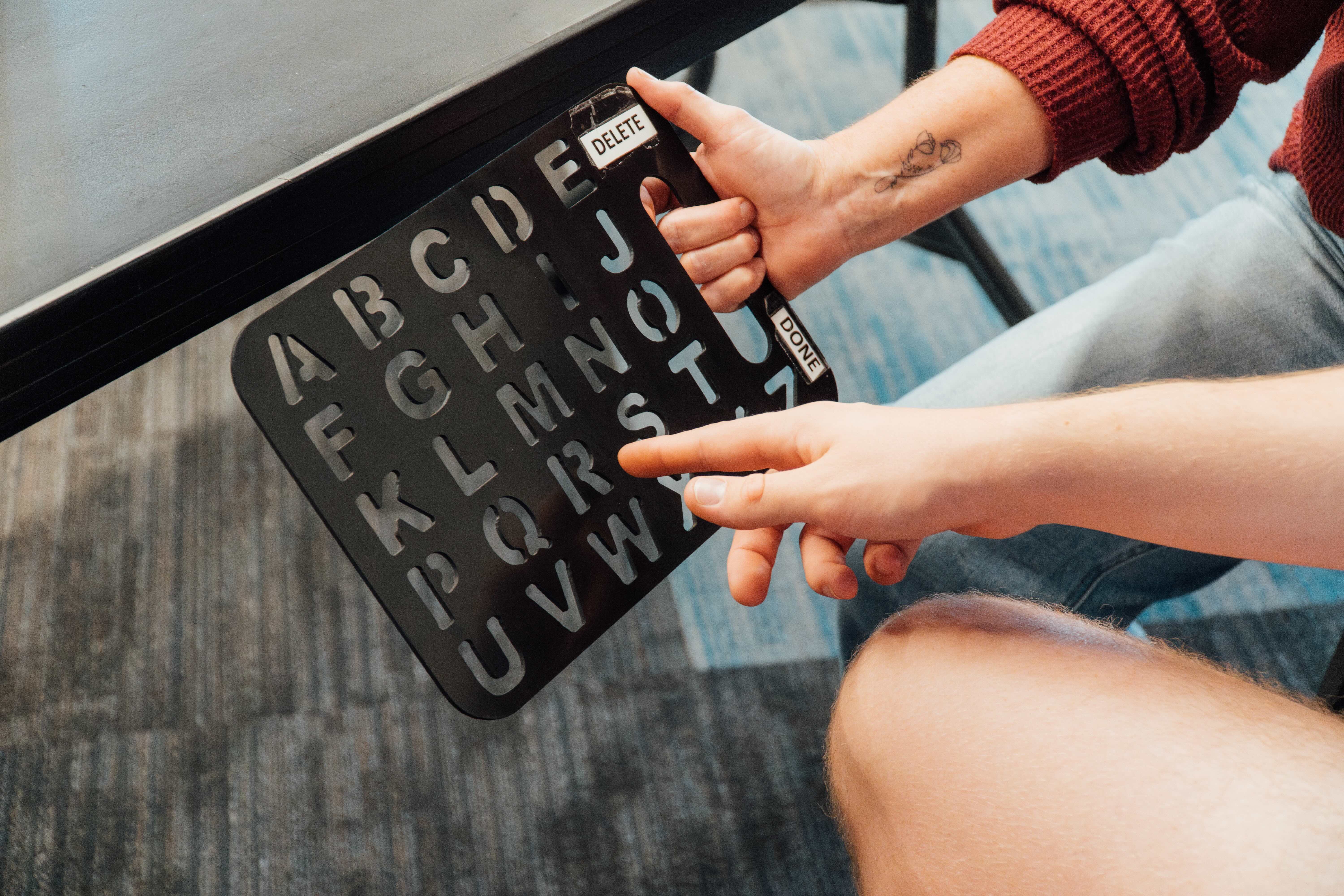
M: By the way, it works with other types of disabilities besides autism. So here is a very simplified explanation, Autism is a movement disorder, not a cognitive disorder. Speech and writing are motor skills. With our spelling therapy, we start with gross motor skills – they tend to be easier for students than fine motor skills. The kids have to sit and point with their whole arm and hand. That’s gross motor skill, and in that, we create new neural pathways in the brain that link gross motor skills to pointing to a letter. That in turn allows a student to access their thoughts through spelling.
It’s a long and drawn-out process. It builds on skills gradually and keeps increasing the skill level. We are trying to get to what we call “open communication.” The process starts with larger letters, and we change boards to refine the spelling communication as a student’s skill level
Q: What is your eventual hope for your spelling students? Where would you like to see them end up?
M: My eventual hope is that my students will be able to “speak” for themselves – even to tell me their hopes. That motivates me in all we do. Additionally, my prayer is for them to achieve open communication with members of their families. That would mean ongoing family conversations, just like what happens in families everywhere, except by a unique means in their case. That’s something many of these families believed to be impossible, until fairly recently. The ability to use their voice will allow them to find and use the gifts God has given them.
Once they gain functional communication, they can experience a much-improved quality of life through expressing themselves on the letterboards. On a grander scale, if I may dream a little, my hope is that the world will see special needs people as God sees them. They are incredibly beautiful works of God and precious to him. They have been overlooked for too long and maybe that can change soon.
Q: Cody’s story is in focus here. You have known and worked with him since he was a boy. How has Cody’s story, especially the spiritual world he describes, affected you?
M: It is hard to put into words all the lessons I have learned just by being Cody’s friend. Romans 8:28 says that for those who love God, all things work together for good. I have seen the truth of this over and over through the years. Cody’s life has already had an amazing impact.
Here are a few examples; because of Cody’s autism, there are people in Romania who have access to a church. Because of Cody’s autism, I was able to train people in Poland in family camps. Because of Cody’s autism, I had the opportunity to train staff in Uganda, and a church in the Philippines, about the Biblical perspective of disability. Because of Cody’s autism, there is a thriving special needs ministry in a church in Mexico. And because of Cody’s autism, there is a thriving and growing ministry here that has served more individuals – and their families – than I can count.
Everyone we have served has heard about Jesus and have a place to call home, if they are looking for that. Cody’s life has touched more parts of the world than most people could ever dream of reaching. It will be a joy to see him enter Heaven and see all the people that are there because of his journey and faithfulness to God in his suffering.
So, Cody’s story hasn’t just affected me; it has completely transformed my life. I try not to be surprised anymore about what God has done, and will do with Cody’s testimony. But I must say this next step of the journey, the view into the spiritual world, caught me by surprise. I am not sure I’ve fully processed it yet. What I do know is that Cody loves God, and I love God; so I trust that He will work something good out of it all. And not just good – as the Bible says, He is able to do exceedingly above all we can ask, or even imagine. That is happening here.
Q: In spelling sessions, Cody repeatedly says that the church’s special needs ministry is important to God, and that you always have an angel with you. As well, he can tell when you are upset, or not feeling well physically. How has all of that unexpected information impacted you and your view of what you do?
M: I have no doubt that the special needs ministry is important to God. We see that over and over again in the Bible. Jesus surrounded himself with those the world considered inferior in some way, or “less than” others around them. The Bible says in 1 Corinthians 12:23-24 that the parts of the body the world sees as “weaker” are actually indispensable and should be treated with greater honor. The fact I appear to have an angel with me all the time is a benefit of being a friend to my friends with disabilities. I am certain it has nothing to do with me, as if I were something special; it has everything to do with them.
To be able to help my students find their voices is a privilege and an honor. All that has happened, including this glimpse into the spiritual world, has only solidified for me what I have always somehow known; people with disabilities and special needs ministry are very important to the Lord.
Q: Let’s take a church that has no special needs outreach like this. What are the most important steps in making something like this happen? And what encouragement would you give?
M: The first step is definitely prayer. I’m not saying that because it is the “correct” Christian response; it is essential to any Christian undertaking, especially one like this. We did that at our church and asked God to guide all that followed. After prayer, we formed a committee of parents, professionals and church leadership to talk through our vision of what a special needs ministry looked like. We did research, looked at existing ministries, and looked for what was working elsewhere. After that, we presented our vision to the church, asked for volunteers, and prayed for students and families to feel welcomed. The church announced what we were doing, and information also tended to get out by word of mouth in the special needs community.
From there, we just continued being faithful to the students God brought us. That led us to add classes and programming, as we felt led and were able to handle the logistics. It did not become large overnight. I always encourage churches to start small and take one step at a time. Don’t look at a church that has been doing it for 20 years and think that is what you need to be doing; we started with one student and no room. Just take the first step of faith and God will lead you the rest of the way.
Luke 14 tells us that when we give a feast, we are to invite the poor, the crippled, the lame and the blind, and that you will be blessed because they cannot repay you. That is what you are doing, literally, when you begin such a ministry. In Luke 21 we also are instructed to go out quickly into the streets and “compel” them to come in so that God’s house will be full. God’s house is not complete without our friends with disabilities. It’s Biblical. He promises to bless us because of it.
We have seen these blessings in so many ways in our church. Career paths have changed, families have been restored, we have had financial blessings, amazing people and volunteers have become part of the church, and most importantly, people have given their lives to the Lord. All this has come from being faithful and including individuals with disabilities in our church family. Doing so changes lives, and it changes hearts. Be prepared for an incredible experience.