
Joe (J): Austin, thanks so much for being available to answer some questions. It has to be challenging to have a microscope turned on the family through a book about Cody.
Austin (A): I think it is actually a cool thing. My focus is that God is using Cody to reach people, and hopefully to help start and grow special needs programs and to raise awareness. Cody has such a powerful story. We know it and live it, but now others will hear it through his own voice. I honestly have no hesitancy over it. It’s a true story that needs to be told and I want people who look at him and wonder, “Could this really be true?” to see that it is.
J: You are two-and-a-half years older than Cody. What are your earliest memories of him?
A: My earliest memory is driving to the hospital to meet him. I remember sitting in the car with my dad, repeating his name to make sure I had it right: Cody James, Cody James. I kept thinking about what our relationship would be like, having a brother and friend, someone to play sports with, and so on. When he was young, I wasn’t expecting him to talk anyway, so not much stands out. But I remember more about the relationship when he was about six, and I was eight. He was diagnosed about four years earlier, and I remember it as a time when he always seemed frustrated. He also started getting aggressive because of his frustration. I remember we were trying to figure it out – most kids get frustrated over something you can see; they get hurt, or are hungry. With Cody, we never knew what was bothering him because he couldn’t tell us. But his frustration led to a really difficult time for the family.
J: Did your understanding that he couldn’t express himself make it better, or worse?
A: Maybe some of both. I understood it wasn’t his fault and that he was having a difficult time. Of course, I felt bad for him and wanted to do what I could. But it was also difficult because there was no way to address it or help him. Back then, the answer to a lot of this kind of behavior was to medicate someone. That happened too, and while it helped with some of the behavior, it clearly didn’t solve anything.
J: Since Cody was diagnosed with autism at age two, you were old enough to understand something was different. How was it first explained to you, and what was your reaction?
A: First, I remember my parents saying he had autism and that he was not a typical kid. They explained to me that he would have certain difficulties. But even way back then, I looked at him and decided to do my best to love him. I was raised in a Christian home and already had some awareness of God and how Jesus was working in my life. It’s amazing to look back now and see that even at so young an age, God works in a heart and gives us understanding. I can honestly say that I was never upset or disappointed. The news was just something I heard, and accepted. Even back then, my thinking was that Cody is my brother and I’ll always be around for him. Of course, I had no idea what that would look like.
J: How would you describe your childhood together?
A: I tried to include Cody in everything I did. My friends knew that Cody would be around with me when we hung out together. But communication was always a big barrier. I wasn’t able to know what he wanted in many cases. I was also very protective of him and stood up to anyone who said something, or who attacked him. The truth is we were very close. I look at old pictures, and we usually have our arms around each other. I knew we were connecting in some way, even though I often didn’t know what he wanted or what was bothering him. But I was there for him anyway. When I ask him today, who is your best friend, he says it is me. When I ask him who is my best friend, he knows and tells me that he is.
J: It would be natural for a child to feel resentment for a sibling if too much attention was paid to the other child. Was that ever an issue for you?
A: This is a tough question, and I want to consider it honestly. Life is difficult, and having a brother with autism is challenging. No relationship is ever perfect, at least not while we’re here on earth. But for a large part, this really was not a big issue for me. I had a football career – I was a starting quarterback for three years in high school – and that brought lots of attention, including college offers. Maybe that was part of it – I didn’t need much attention because it was coming from other sources. But I could see this as a problem in many cases, where a child who wants more attention, or feels starved for it, could have some resentment.
Another thing that helped a lot was that there was never a sense of competition for attention with my parents. They were always there for me and very supportive. And more than that, they included me in the family discussions about Cody. It made me mature quicker, and change my focus off myself and on to Cody and his special challenges. So rather than competition, it felt more like I was on a team looking to help him as much as possible. I’ve always played team sports, so the idea of a team approach came naturally. That was a big part of helping to see Cody as a family member we were loving and not as a source of competition for attention.
J: Your parents described the challenges at times of being in public if Cody acted up. But it sounds like you had a remarkably mature and wise view of it as a kid. What was your advice, and how did people react to what you did?
A: I’ll share one story, and the credit for this is only the Holy Spirit in me. We were in a grocery store at the check-out area and Cody was about five. He was throwing a tantrum and my poor mom was getting frazzled. People around us were giving looks, and there are always a good number of unkind expressions. You can see the thoughts: why don’t you control your kid in public?
We left the store, and I said to my mom, the best thing you can do at times like this is just smile at people. They don’t know what is going on, or what Cody’s life is like. My mom tends to want people to be happy and is a peace-maker. So those kinds of looks really would get to her, more than for some other people. It had to be grace from the Holy Spirit for me to see how that was measuring up as we left the store, and to have the right words. So much of life around us is driven by emotions – like when someone cuts you off on the road. This was something she had no control over and the words went right to her heart. These people truly don’t know or understand. Don’t get drawn into a negative moment. You and I know what is happening, so just smile and be gracious – even if they are not.
There are plenty of other stories like that, but my advice to families experiencing something like this is to try to rise above it. People really don’t know what your life is like. Make the best of it and don’t feel the need to explain to people. Plus, remember everyone has perspectives. The person who acts the worst is often the one with their own problems. I’ve seen this over and over in life. People project their own frustrations onto others. I remind myself that something is driving their reaction, and I need to show grace back.
J: You were an accomplished football player and Cody used to come to your high school games. What memories do you have of that?
A: I mentioned earlier how I always tried to support Cody, but he was there to support me too. He actually was a popular kid and people loved him. All the team families knew him and were friendly. He would yell out: Go Desert Mountain Football! Go Wolves! He was a real team fan. He never missed a game, and when I looked up in the stands, he would wave to me.
This was something unexpected. I was trying to support Cody, but looking back on it now, I realize even more that he was there for me. It was part of the life-long bond between us.
Cody is still a big football fan – he likes the Cardinals, and also the Phoenix Suns. He understands the game – the basics for certain – and we celebrate together with a great play. He sits with me and watches games and you can tell he is enjoying the experience. Football has always been a part of our family life and he is as much a part of that as the rest of us. The limits he has in his life don’t prevent him from enjoying sports, especially watching with his family.
J: How would you describe your relationship with Cody now? You are probably closer to him than any other person, and know him as well as anyone. What does your relationship look like?
A: Just like any relationship, it has grown through the years. People learn to be there for each other and to be sensitive to another person’s needs. It’s really just like that, except I factor in the special needs part. That creates some challenges for us, but even with that difficulty in communication, I can tell when he’s really struggling. For example, when he hears a noise that is too loud, or he is having trouble composing himself, I see it quickly. But think about it- that’s something friends do for each other. We know what bothers people close to us and when we can be there to help or reassure someone. That’s true in any relationship.
Here’s an example. Cody has anxiety around dogs. I don’t know why – it might be the running or sudden loud barking – but he has it. I’m able to recognize it before it hits him, and to help him calm down and walk away from it. It’s really like any relationship, except that I have to be sensitive to those extra kinds of challenges for him.
We’re very close though – we do a lot together. I’ve always tried to be there for him and the closeness continues to grow. And it’s not one-way; he is there for me too. I remember during his aggressive stage, he might grab my arm and pinch me, or something like that. He would always come back, rub the spot he pinched, and say something like: Austin and Cody are friends. That kind of effort on his part meant a lot to me and it showed how real the connection was between us.
This might be difficult for people to get, but I think we are closer to each other because of his autism. It has made me more protective of him and wanting to be there for him. As well, he trusts me so much that I help to regulate him. That’s a unique kind of bond that is hard to describe to people. There is something in it that makes the friendship deeper and more real.
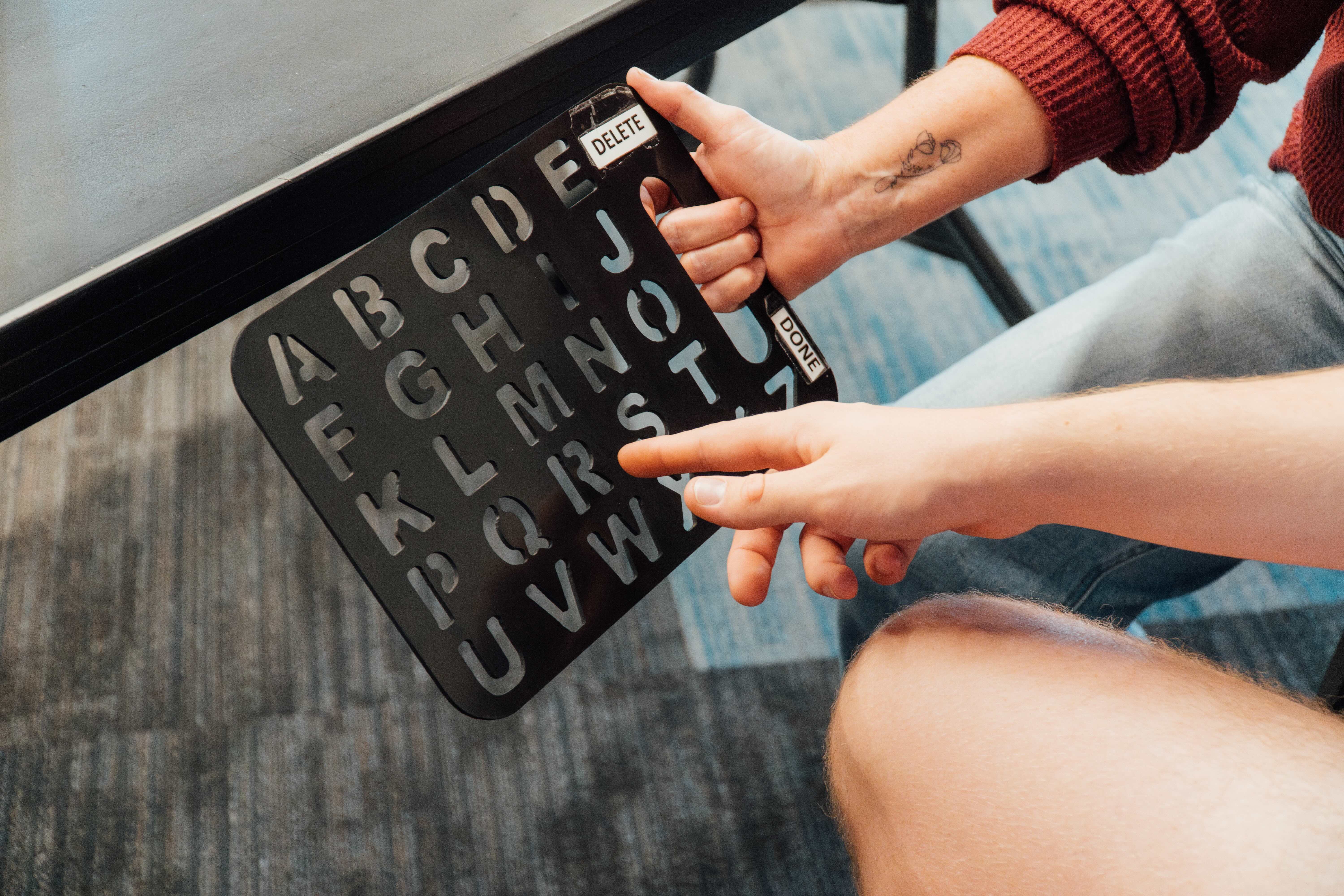
J: Speaking of that subject, Cody has said that you are one of the very few people who help “regulate” him. He also said that you help him be more independent. Can you explain that for us?
A: Yes. A lot of times people with special needs are treated as children. That happens in both how people talk to him and how they act around him. Cody is very aware of how people around him interact with him. I’ve always talked to him and treated him like the man that he is. It’s interesting – I did that to some degree even before we knew how much he understood from the spelling. I never talked down to him and spoke as much as possible like I was addressing the real person inside him. I didn’t know the magnitude of his understanding, but now I see how much got through to him that I didn’t know at the time. I was not talking down to him, or patronizing him.
That sent a message that I cared about him, more than I realized. It created the trust and respect that allows him to rest and calm himself when I speak to him. He trusts me, because of a lifetime of experience. Now he can communicate to tell me what he needs to be regulated. For example, when he shared his testimony before the whole church on an Easter Sunday, he told me what help he needed. I went up on the stage with him, and he did great – but he recognized the challenge and told me beforehand how I could help.
J: That’s interesting. I have seen Missy remind him of ways to stay regulated, like certain types of exercises. The two of you have a very high trust level for him. Has Cody’s spelling progress and getting a job surprised you? Or did you see some potential in him even before the spelling breakthrough?
A: I always believed that Cody was very intelligent and knew what was going on. When we would hang out together, I knew he was understanding things between us. But to be candid I never thought we would have the level of communication we have now. I figured it would have to wait until we got to Heaven. I used to think of that, and how much fun it would be on that day when we were together, and I saw and heard the fullness of who God made him to be.
There was no way I could have seen the level of communication that spelling has opened up. And I see the progress in it. It’s like any skill that someone practices. I can see he is improving and getting more skilled at communicating. I think the day will come when he can sit in front of a keyboard and we’ll talk just the way we are now. It seems incredible at times to see that in reach, since it’s not something I honestly saw or could have imagined years ago.
J: You are strongly grounded in your Christian faith. How has that figured into your relationship with Cody?
A: First, support from the church body has been indispensable. Without that, I can’t imagine where we would be. People like Missy and Jenna have loved him and helped him so much. He has felt a sense of community and belonging. As well, the church body beyond that has been an incredible support. Cody talks about how much the church body has meant to him, and how people in church view him with love, and not as the world sees him.
My own faith has grown as well because of Cody. His autism is part of the process that has made me the man I am today and made me want more of the fruits of the Spirit in my life. People around me, who have mentored or influenced my faith, showed me how to view others with kindness and gentleness, no matter who they are or what they look like. That kind of approach inevitably influenced how I saw and responded to Cody. I think my faith in Christ is actually stronger for having Cody in my life and loving him for who he is.
J: What lessons have you learned from having Cody as a brother? How has he impacted the way you approach life and faith?
A: One lesson is that sometimes silence is good. Cody’s lack of voice has allowed him to be more observant, and to understand things that come from being a better listener. Like many people, I can have a tendency to talk too much, sometimes just to fill the silence. We don’t like too much quiet with people. Cody has taught me to pull back and be slower to speak – as the Bible instructs – and to be more thoughtful about what is happening around me.
Also, I have learned a lot from Cody’s dependence on the Lord. He experiences difficulties on a daily basis that are hard for most of us to imagine. How he bears it gives some perspective to the kinds of difficulties I face in life. Cody has had no option but to give his difficulties to God. Growing up with people who did not know how to relate to him made his time with God that much more important to him.
I’m his older brother and there is a tendency for younger siblings to look up to the older ones. But I look up to him, especially when I think about how challenging his life has been, and how he has borne up under it, by God’s grace.
J: Do you think Cody’s life has lessons for all of us, and if so, what would some of those be?
A: Yes, of course. I’ve just mentioned a few in my last answer. First, I would add this from Genesis 1:27: “God created man in his likeness and image.” That teaches us that everyone is an image-bearer of God and we should see everyone that way. No matter what someone looks or sounds like, we should have humility and see them as a special creation and treat them that way.
Also, I think we all can learn to see things on a deeper level – to see true hurts and needs in every life. We all try to look good and to sound like we have it all together. But we don’t. We want people to extend that grace and kindness to us, but we also do well to learn how important it is that we do that for others.
J: Anything else you would like to add?
A: My advice to anyone reading this book would be the same advice Cody has given many times. Namely, that we need to trust God and give our cares over to him. If we acknowledge him in all our ways, He will direct our paths. For a last word, I would add this – Cody has an eternal perspective. It has been forced on him by his autism, but it is actually the best perspective for any of us. The more we live and see things around us that way, the more our lives will be successful by the only standard that will matter in eternity.